Slide 1: Title Slide
- Title: Advanced Policy Gradient Methods: TRPO & PPO
- Session: YBIGTA SUMMER SESSION
- Presenter: DS 26 Jungmook Kang
- Date: 2025.08.26

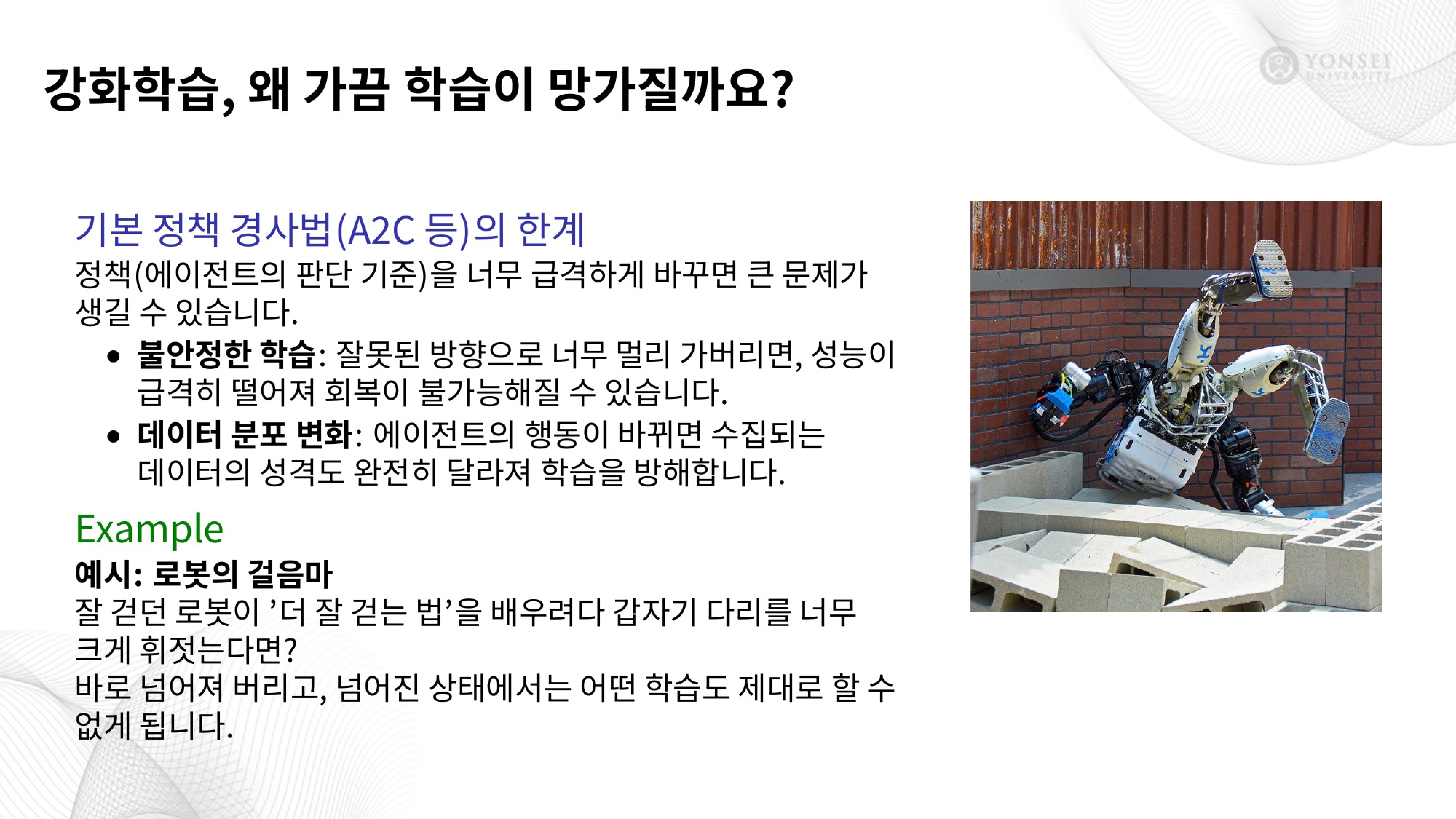
Slide 2-5: Why does Reinforcement Learning sometimes fail?
- Main Question: “Why does reinforcement learning sometimes break down?”
- Problem: Basic policy gradient methods (like A2C) have limitations. Making drastic changes to the policy—the agent’s decision-making criteria—can cause significant problems.
- Key Issues:
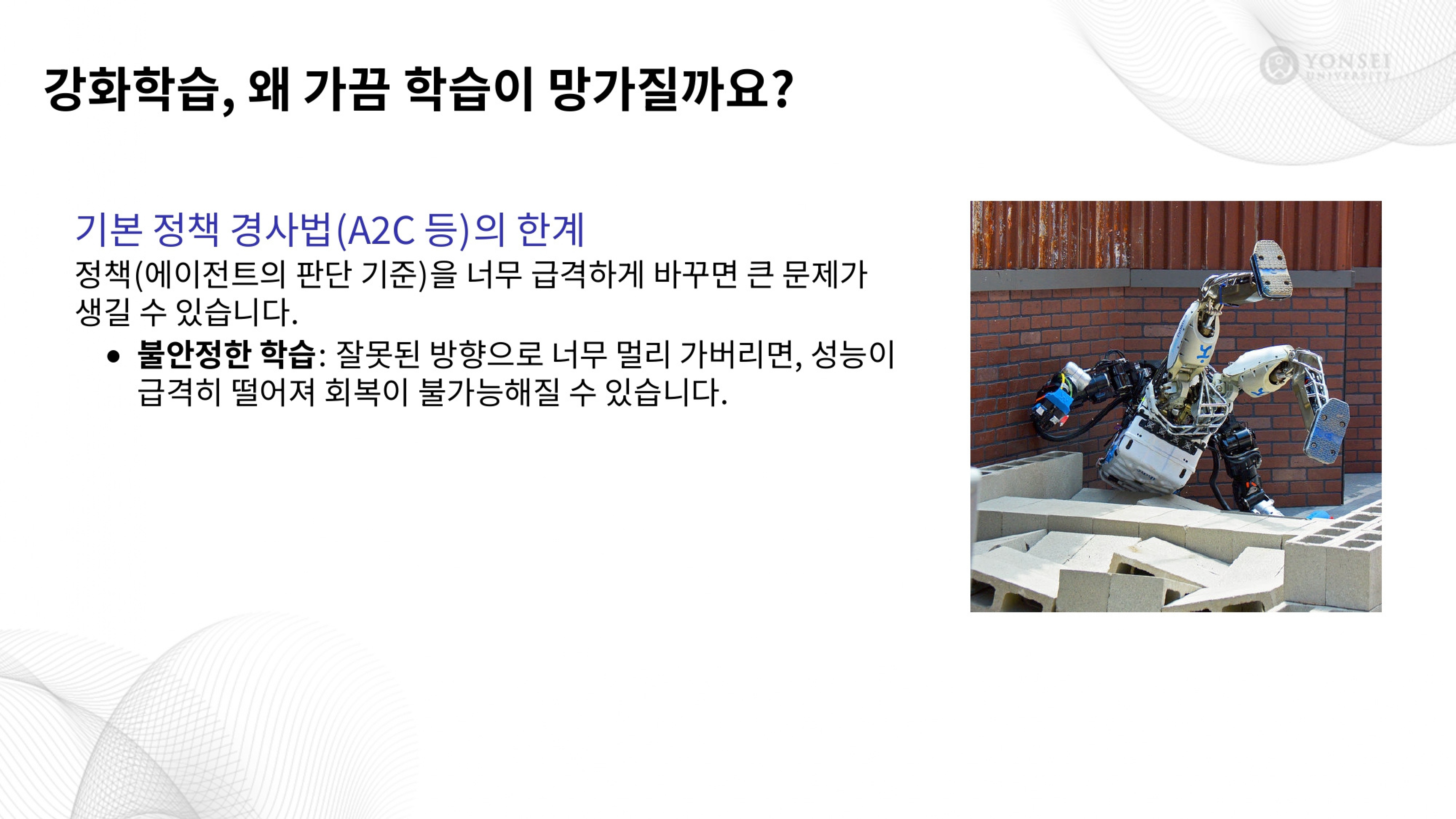
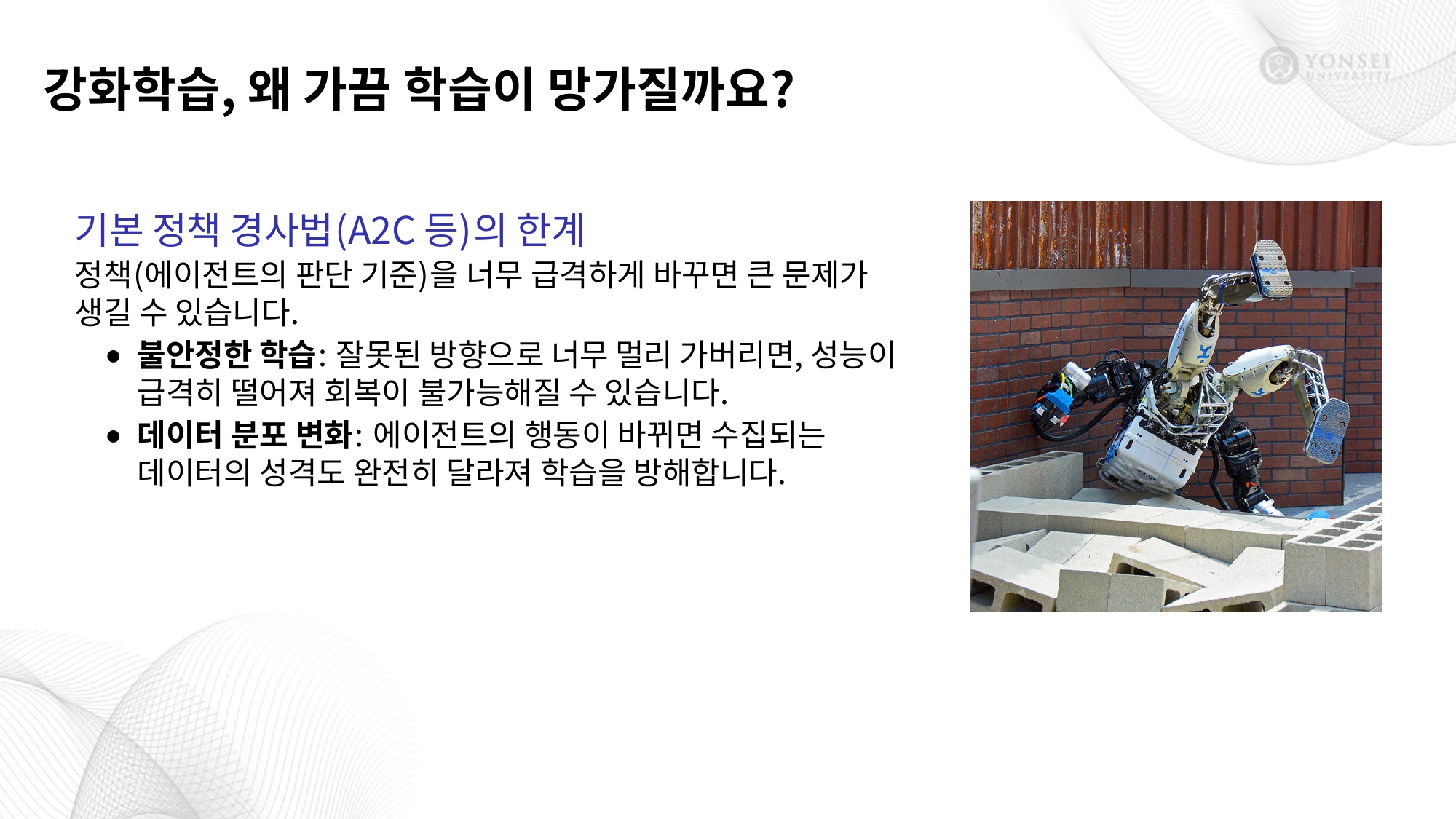
- Unstable Learning: If an update step is too large and in the wrong direction, the agent’s performance can collapse, making recovery impossible. This is more damaging than in supervised learning because a bad policy affects the distribution of states and rewards the agent will see in the future.
- Changing Data Distribution: As the policy changes, the data (states, actions, rewards) it collects also changes. This non-stationarity of the input data makes learning difficult.
- Example Analogy: A robot learning to walk. If it’s walking well and tries a new strategy by swinging its legs too wide, it will fall. Once it has fallen, it can no longer collect useful data about walking, and learning stops.
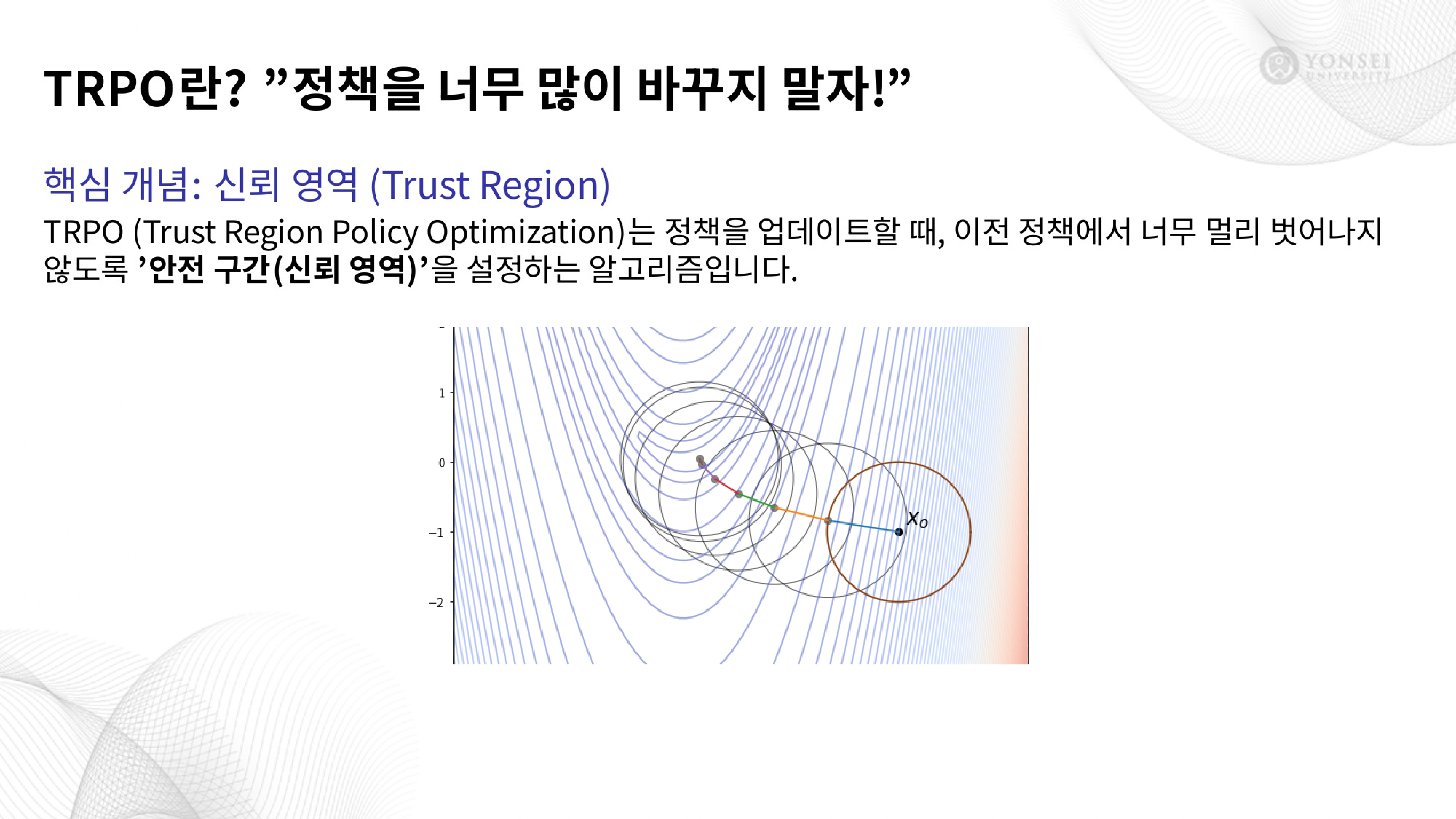
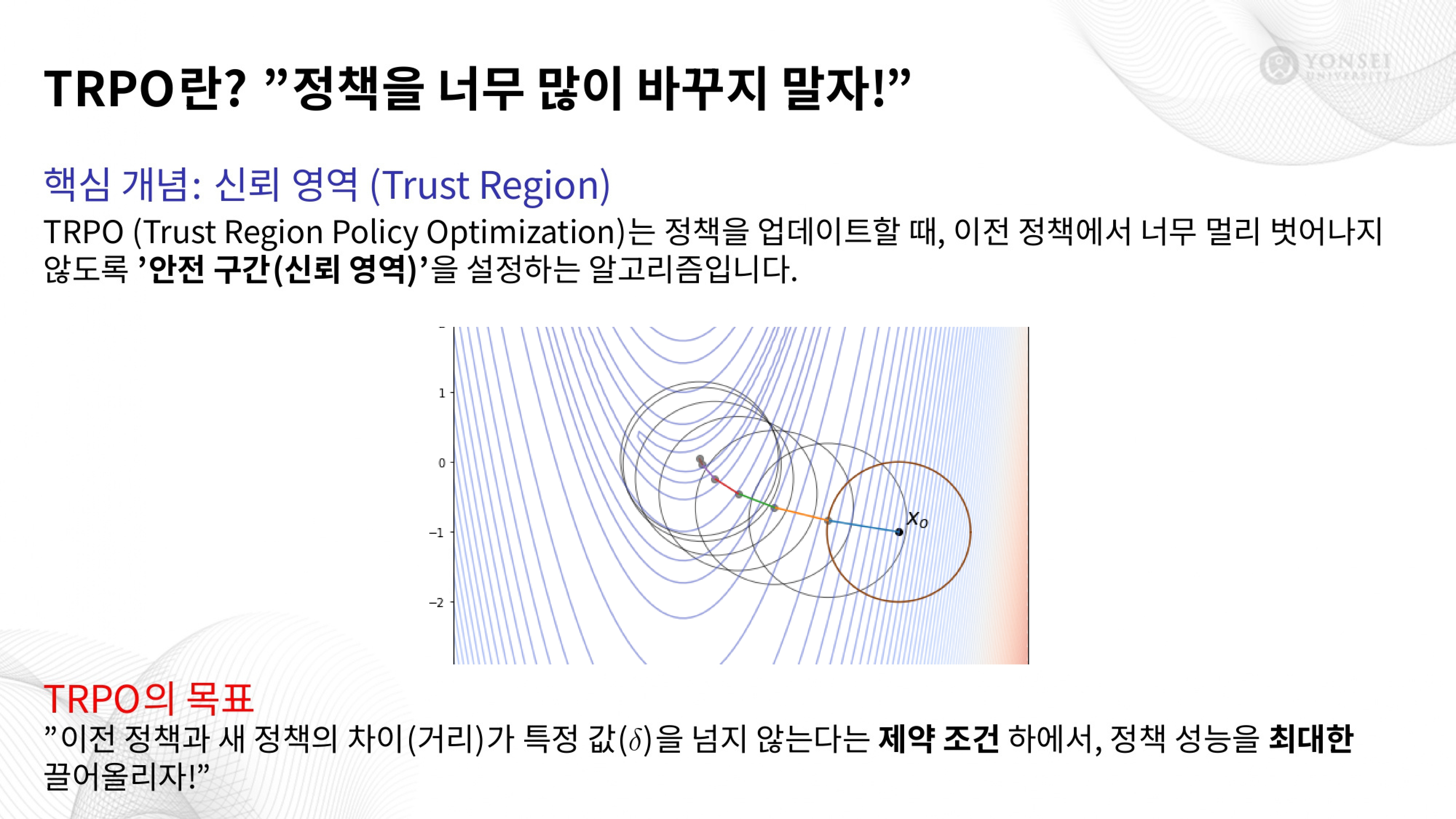
Slide 6-8: What is TRPO? “Let’s not change the policy too much!”
- Concept: Trust Region Policy Optimization (TRPO).
- Core Idea: When updating the policy, TRPO establishes a “trust region” or a “safe zone” to ensure the new policy does not stray too far from the old one.
- Goal: “Maximize policy performance under the constraint that the difference (distance) between the old and new policies does not exceed a certain value, δ.” This prevents the destructive, large policy updates that can lead to performance collapse.
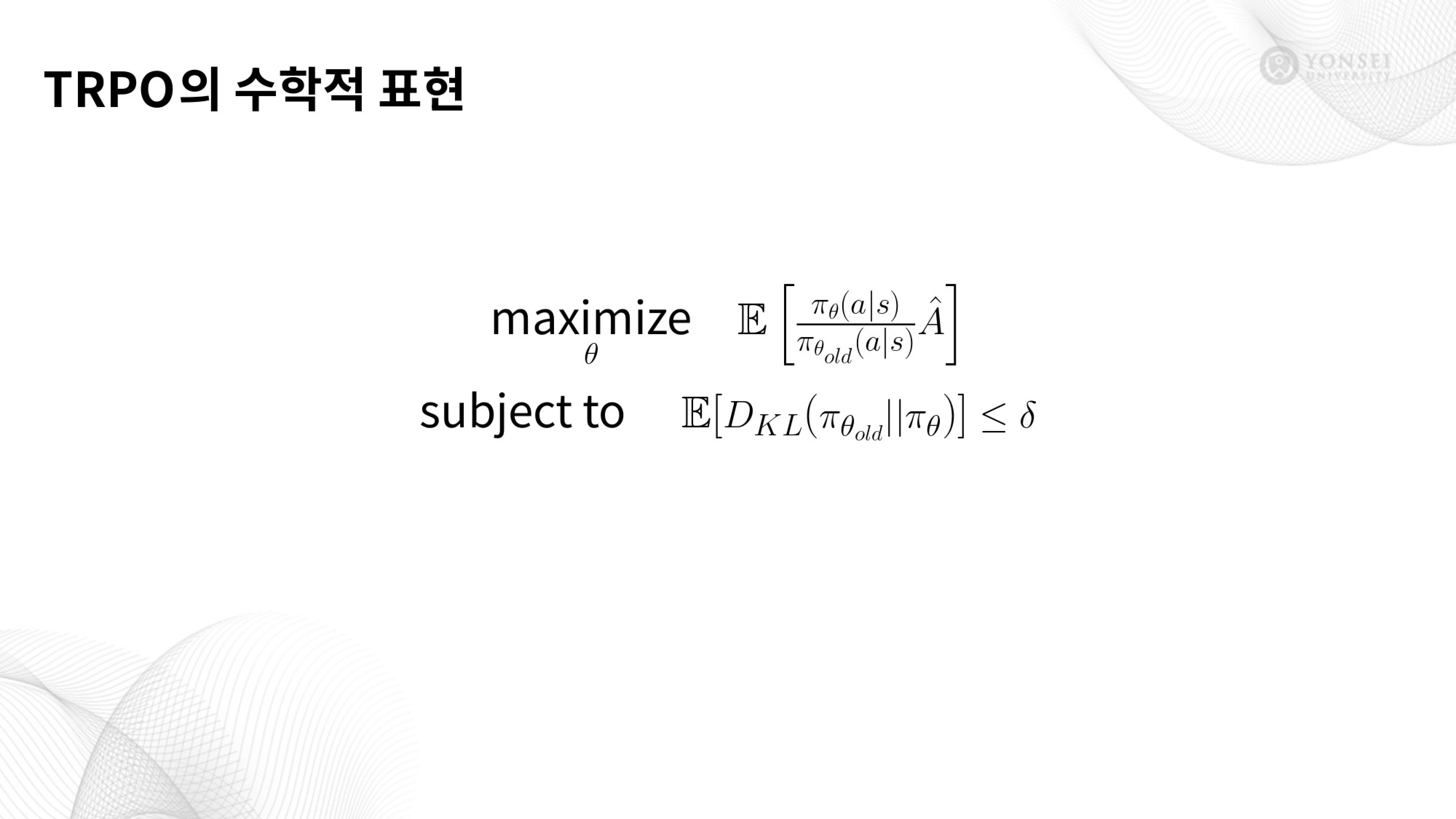
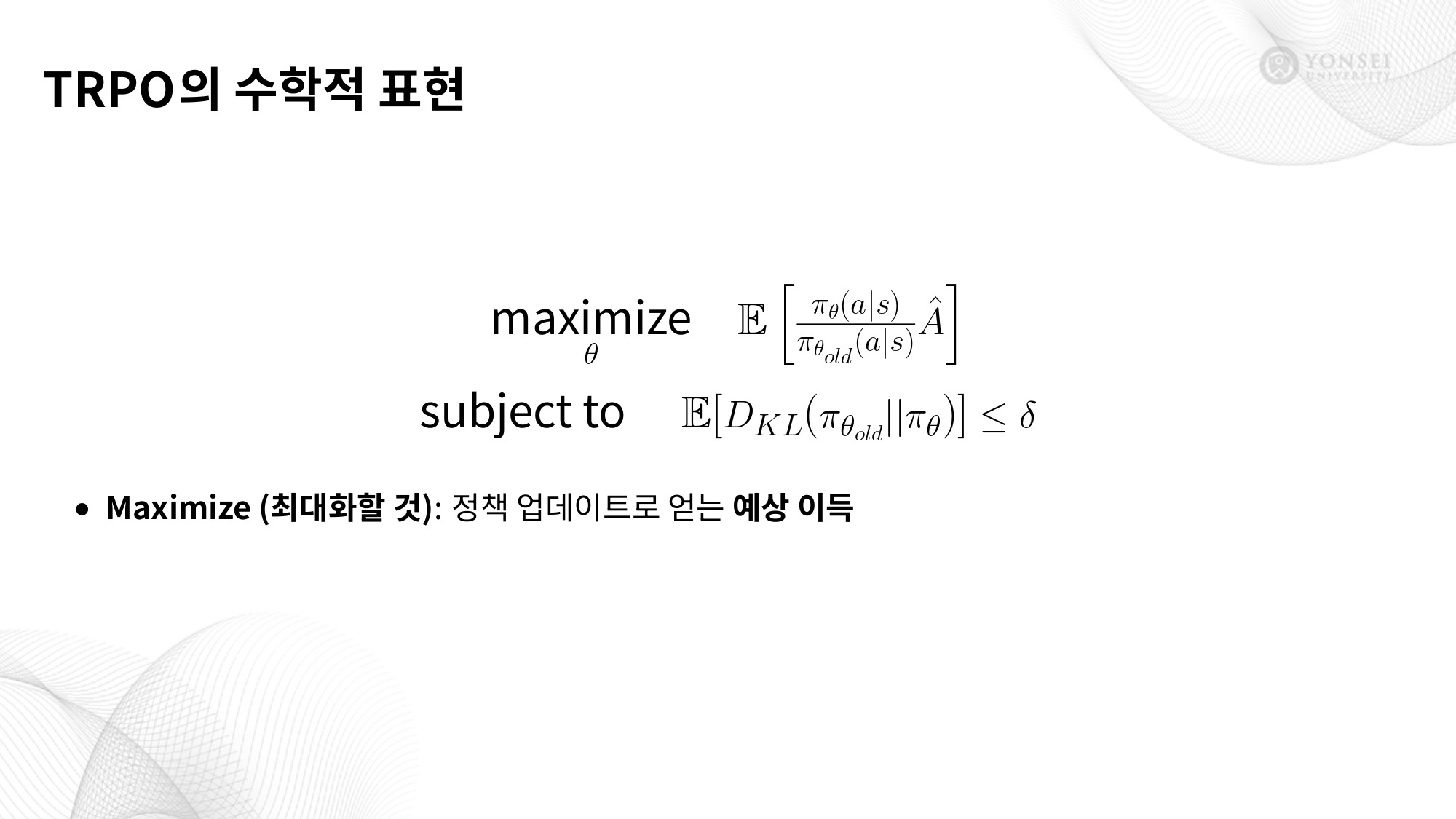
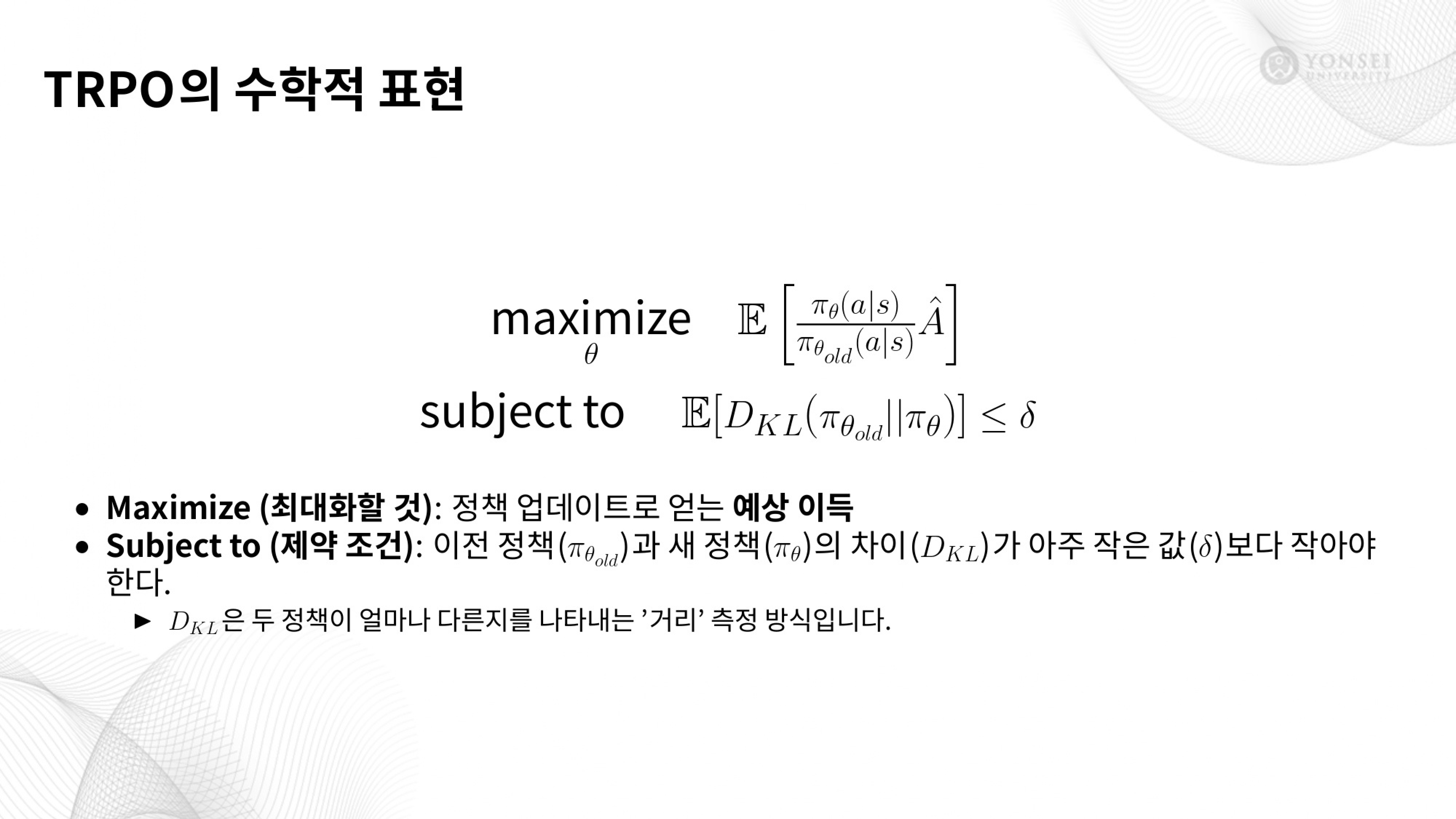
Slide 9-11: The Mathematical Expression of TRPO
This slide introduces the core optimization problem of TRPO. The goal is to maximize an objective function, subject to a constraint.
- Objective Function (What to Maximize):
- The expression $\mathbb{E}[\frac{\pi_{\theta}(a|s)}{\pi_{\theta_{old}}(a|s)}\hat{A}]$ represents the expected advantage of the new policy $\pi_{\theta}$ relative to the old policy $\pi_{\theta_{old}}$.
- This is a surrogate objective that uses importance sampling to estimate the performance of the new policy using data collected from the old one. The term $\frac{\pi_{\theta}(a|s)}{\pi_{\theta_{old}}(a|s)}$ is the importance sampling ratio. The full objective function is:
$$
L_{\theta_{old}}^{IS}(\theta)=\hat{\mathbb{E}}_{t}\left[\frac{\pi_{\theta}(a_{t}\mid s_{t})}{\pi_{\theta_{old}}(a_{t}\mid s_{t})}\hat{A}_{t}\right]
$$
- Constraint (The “Trust Region”):
- The term $\mathbb{E}[D_{KL}(\pi_{\theta_{old}}||\pi_{\theta})]\le\delta$ is the constraint that defines the trust region.
- $D_{KL}$ stands for Kullback-Leibler (KL) Divergence. It’s a way to measure the “distance” or difference between two probability distributions. Here, it measures how much the new policy $\pi_{\theta}$ has changed from the old policy $\pi_{\theta_{old}}$.
- By keeping this value less than a small constant $\delta$, we ensure the policy update is small and stays within a “trusted” region where the performance estimate is reliable.
The full optimization problem solved by TRPO is:
$$
\underset{\theta}{\text{maximize}} \quad \hat{\mathbb{E}}_{t}\left[\frac{\pi_{\theta}(a_{t}|s_{t})}{\pi_{\theta_{old}}(a_{t}|s_{t})}\hat{A}_{t}\right]
$$
$$
\text{subject to} \quad \hat{\mathbb{E}}_{t}\left[KL\big(\pi_{\theta_{old}}(\cdot|s_{t}),\,\pi_{\theta}(\cdot|s_{t})\big)\right]\le\delta
$$
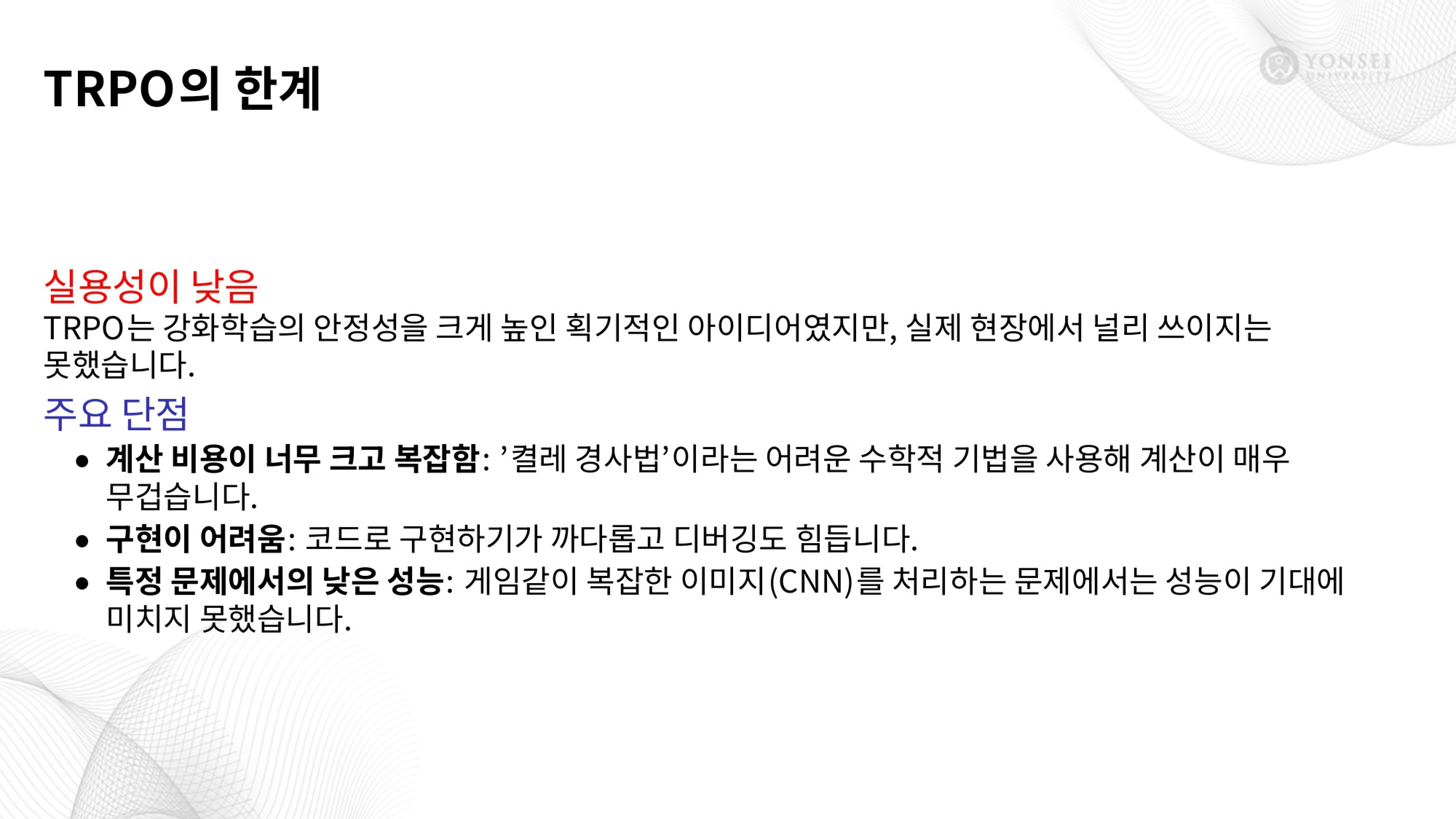
Slide 12: Limitations of TRPO
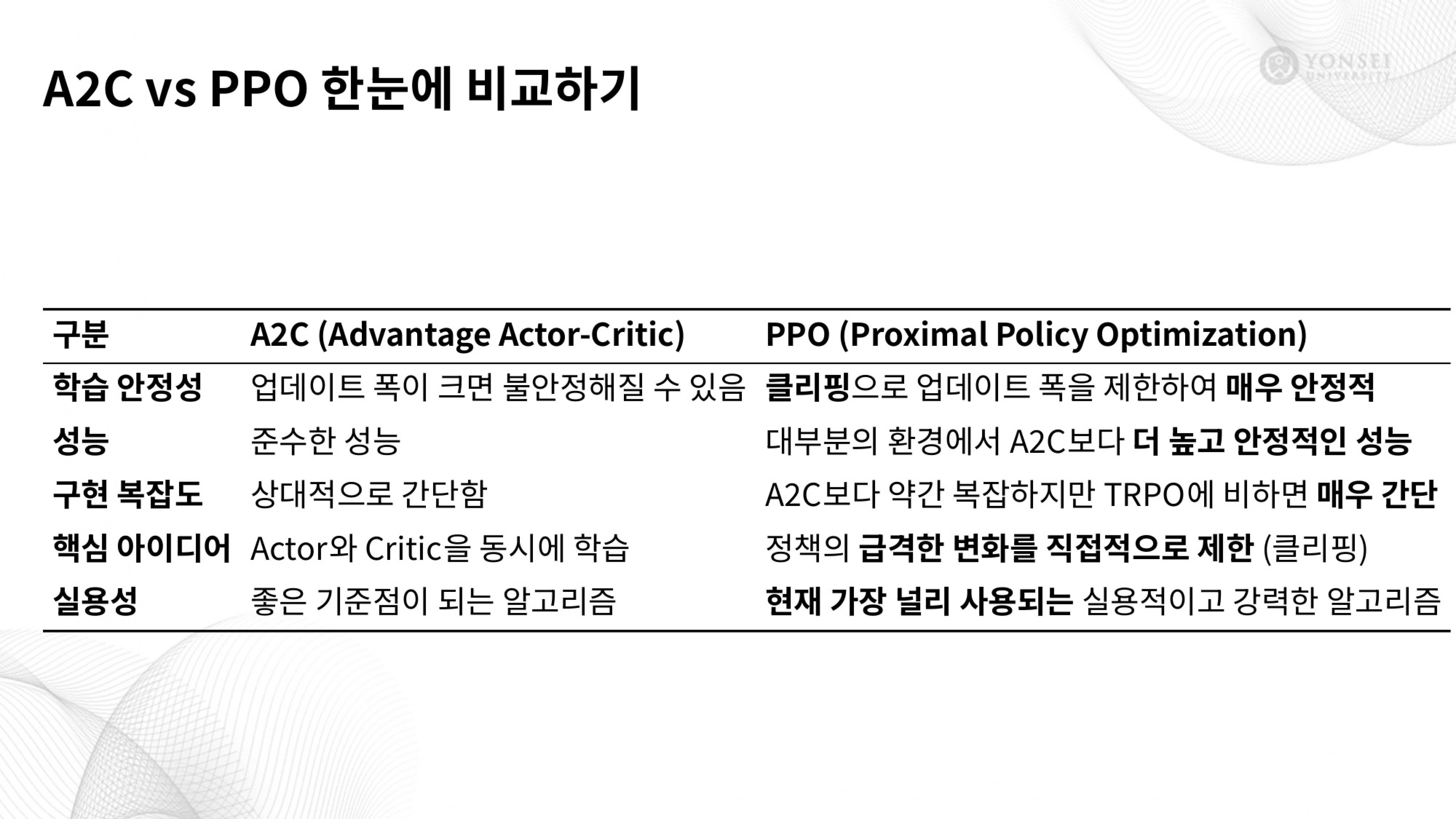
- Problem: While TRPO’s core idea was groundbreaking for stabilizing RL, it wasn’t widely adopted in practice.
- Major Drawbacks:
- High Computational Cost: It uses a complex, second-order optimization technique called the “conjugate gradient method” which is computationally heavy.
- Difficult to Implement: The algorithm is complex to code and debug.
- Poor Performance on Certain Tasks: It struggled with tasks involving complex visual inputs (requiring deep CNNs), such as the Atari benchmark. It is also hard to use with architectures that have multiple outputs (e.g., a policy and a value function).
Slide 13-14: PPO: The Practical Version of TRPO
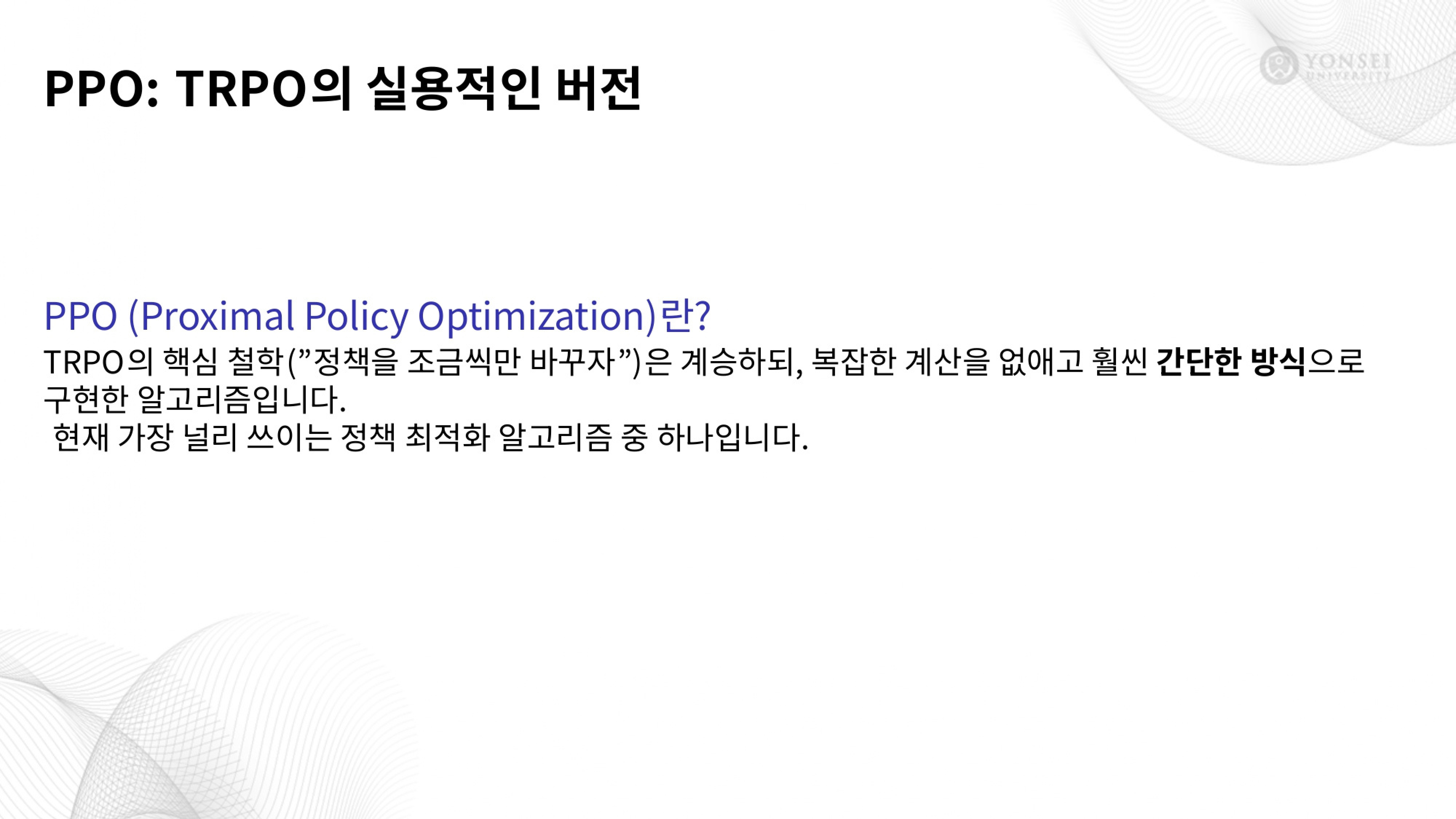
- Concept: Proximal Policy Optimization (PPO).
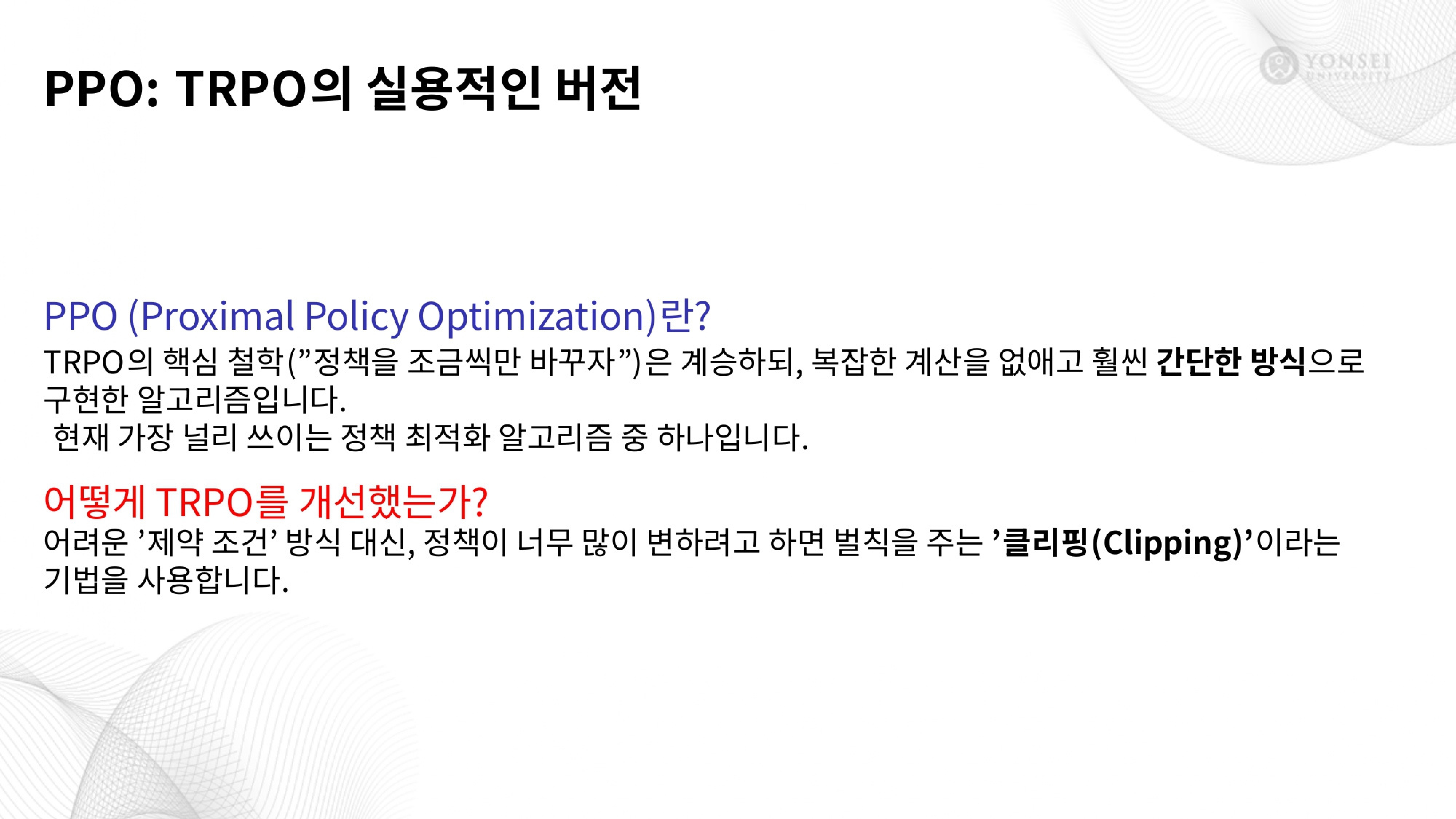
- Core Idea: PPO inherits TRPO’s philosophy of “let’s change the policy a little at a time” but replaces the complex and strict trust region constraint with a simpler mechanism that is easier to implement and more efficient.
- How it Improves on TRPO: Instead of using a hard constraint, PPO modifies the objective function to penalize policies that move too far away from the old policy. The most common technique for this is called Clipping.
- Impact: PPO is now one of the most widely used policy optimization algorithms due to its simplicity, stability, and strong performance.
Slide 15-19: PPO’s Core Idea: Clipping
This section details the PPO-Clip objective function, which is the key to its success.
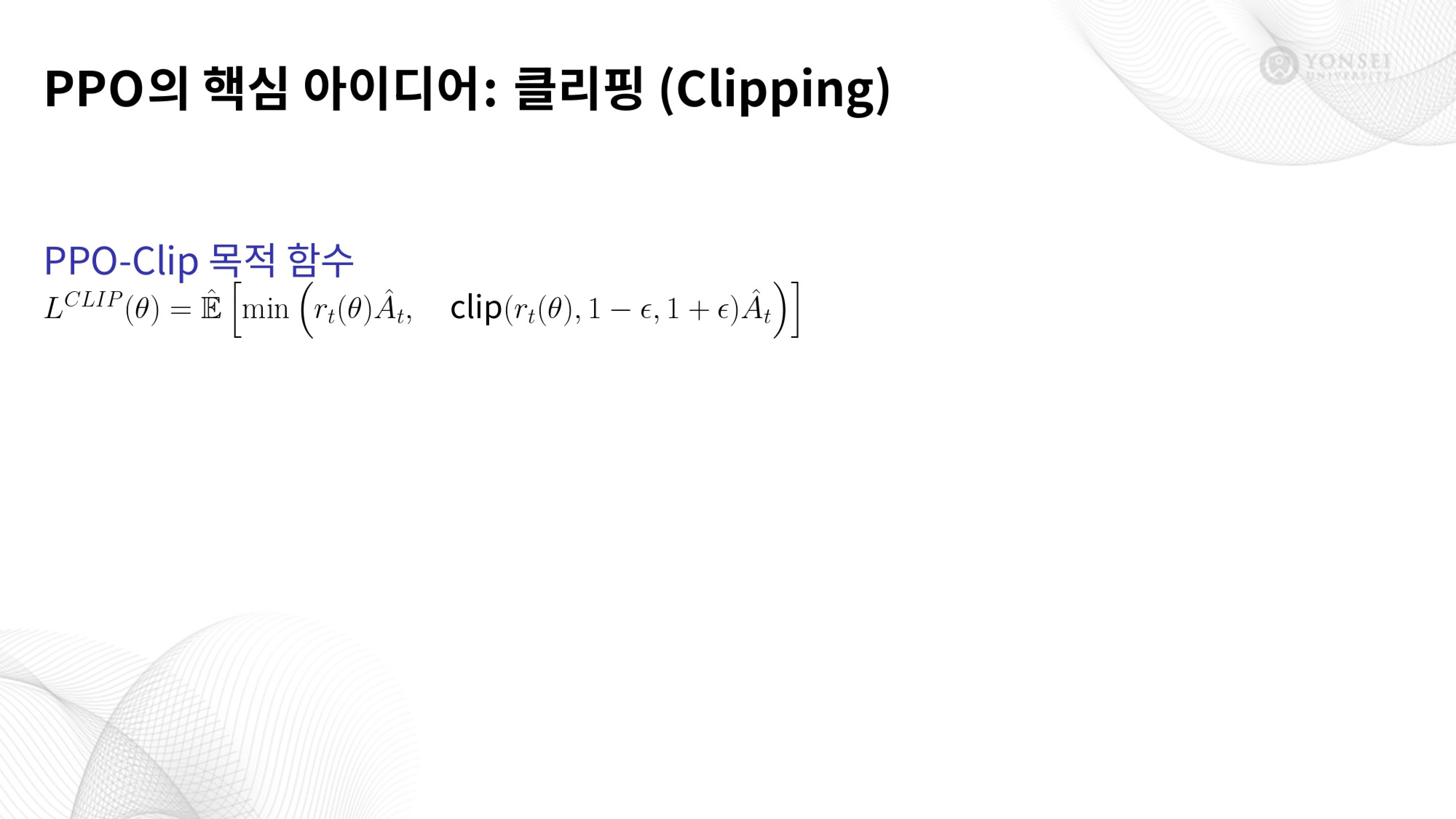
- PPO-Clip Objective Function:
$$
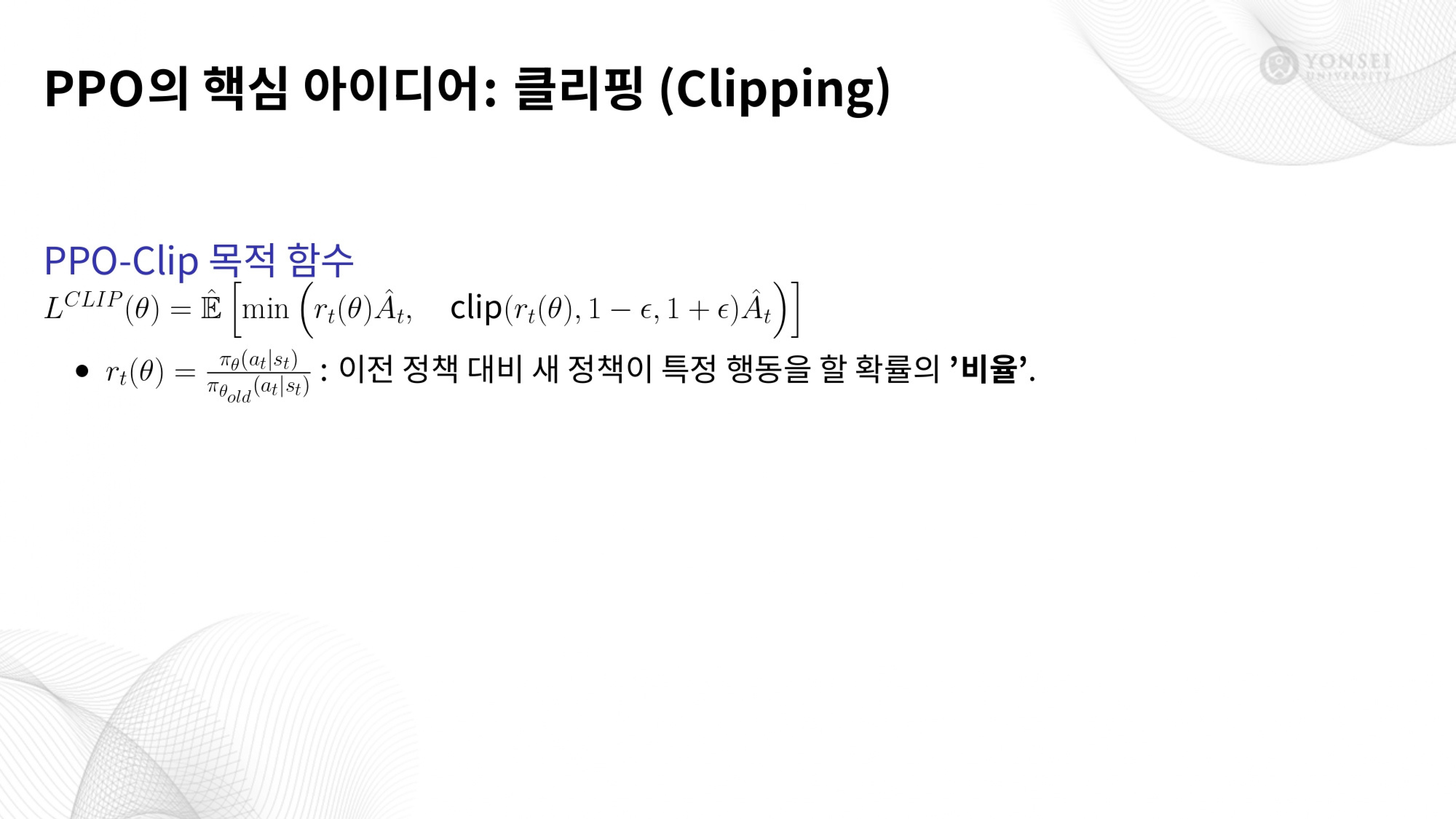
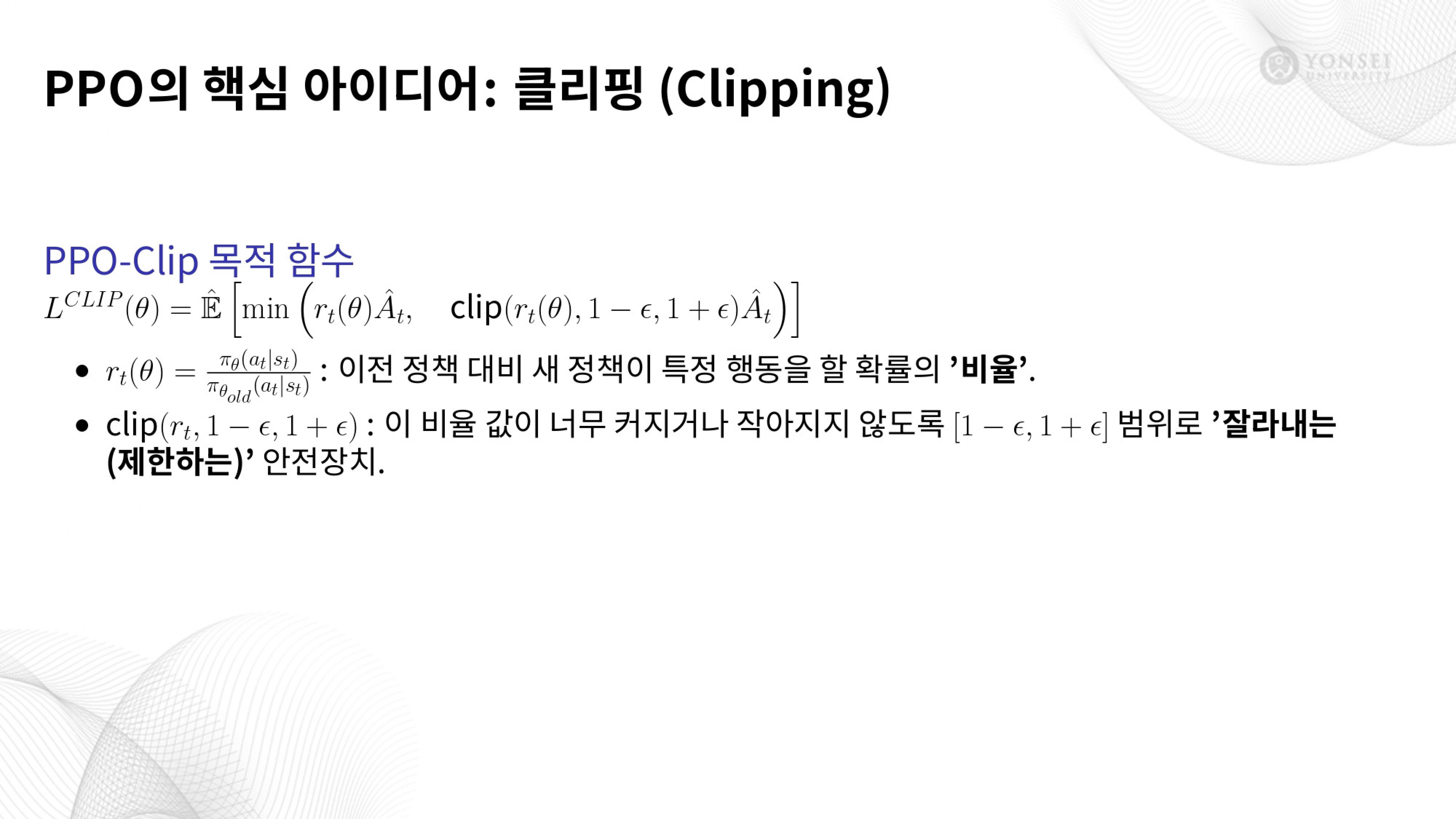
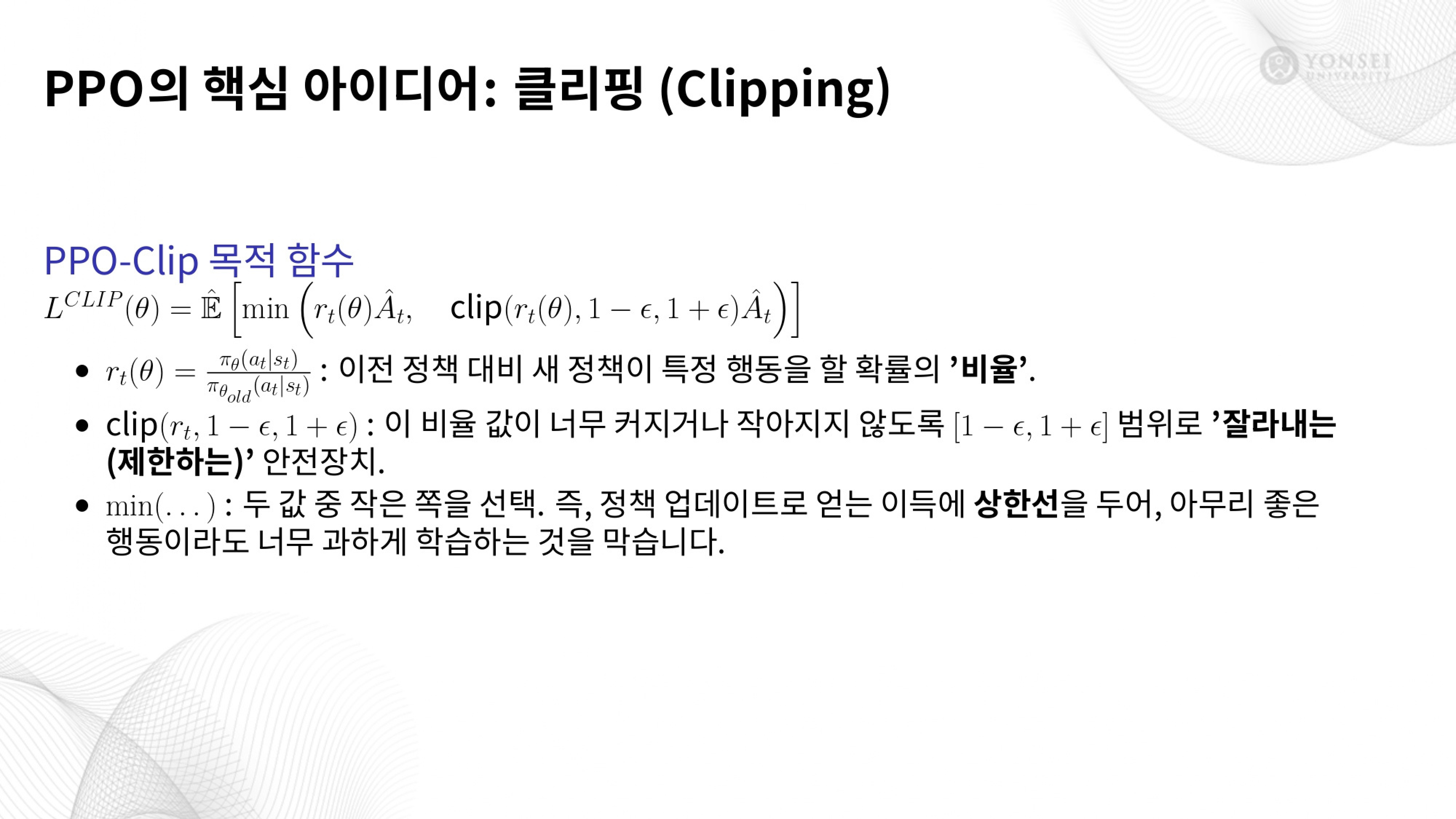
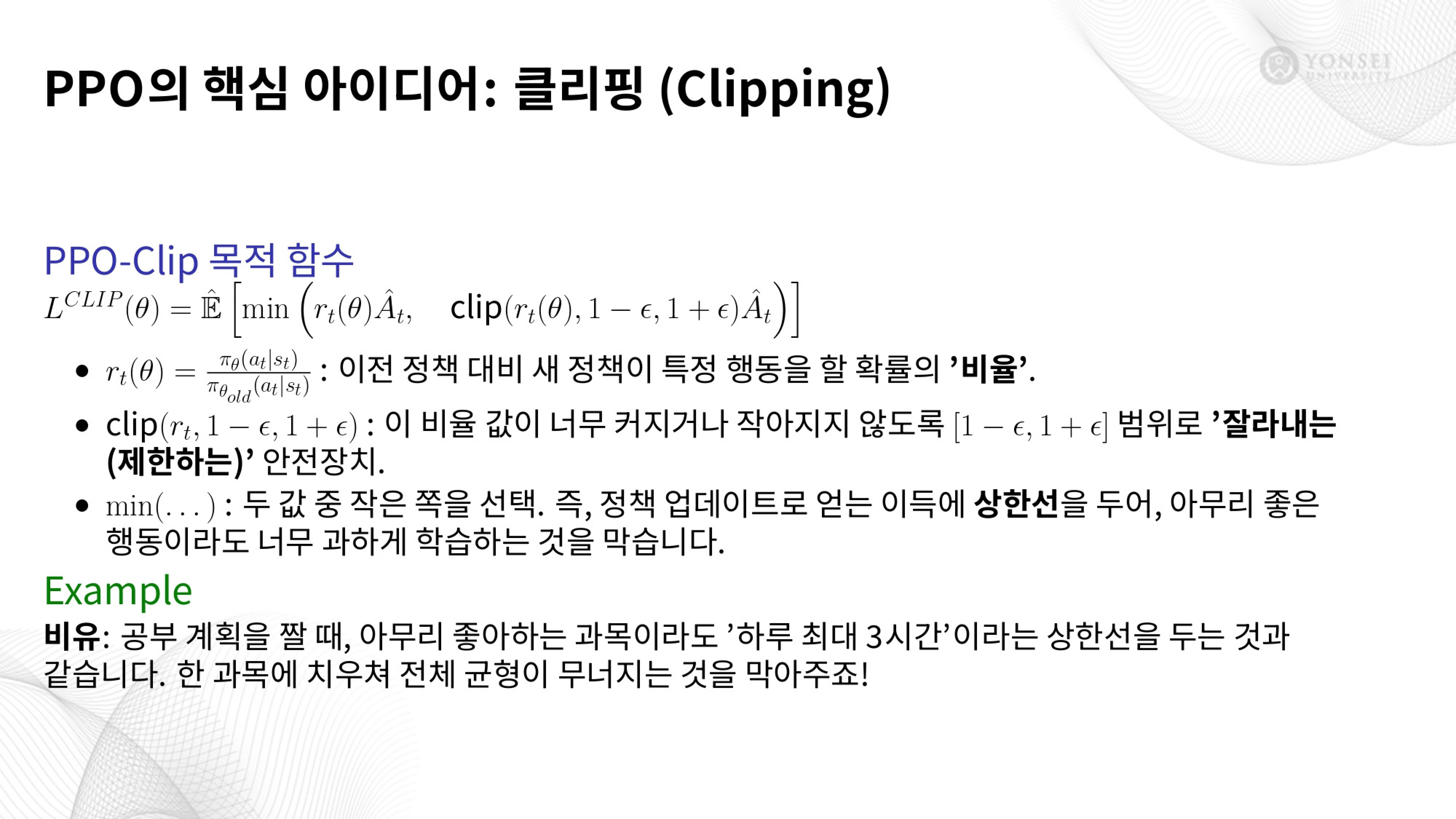
L^{CLIP}(\theta)=\hat{\mathbb{E}}\left[\min\big(r_{t}(\theta)\hat{A}_{t},\ \operatorname{clip}(r_{t}(\theta),1-\epsilon,1+\epsilon)\hat{A}_{t}\big)\right]
$$
Breakdown of Terms:
- $r_{t}(\theta)=\frac{\pi_{\theta}(a_{t}|s_{t})}{\pi_{\theta_{old}}(a_{t}|s_{t})}$: This is the same probability ratio used in TRPO. It indicates whether an action is more or less likely under the new policy compared to the old one.
- $clip(r_{t}(\theta),1-\epsilon,1+\epsilon)$: This is the clipping mechanism. It forces the probability ratio $r_t(\theta)$ to stay within a small range, $[1-\epsilon, 1+\epsilon]$ (e.g., [0.8, 1.2]). This acts as a safety rail, preventing the ratio from becoming too large or too small.
- $min(…)$: The final objective takes the minimum of two values:
- The original objective ($r_{t}(\theta)\hat{A}_{t}$)
- The clipped objective ($clip(…)\hat{A}_{t}$)
- By taking the minimum, PPO creates a pessimistic, lower-bound estimate of the policy’s performance. This effectively puts a cap on the benefit you can get from a single update, which discourages excessively large changes to the policy.
Analogy: It’s like setting a study plan. No matter how much you enjoy one subject, you cap its study time at “a maximum of 3 hours per day.” This prevents you from neglecting other subjects and keeps your overall learning balanced and stable.
Slide 20-21: The Power and Application of PPO
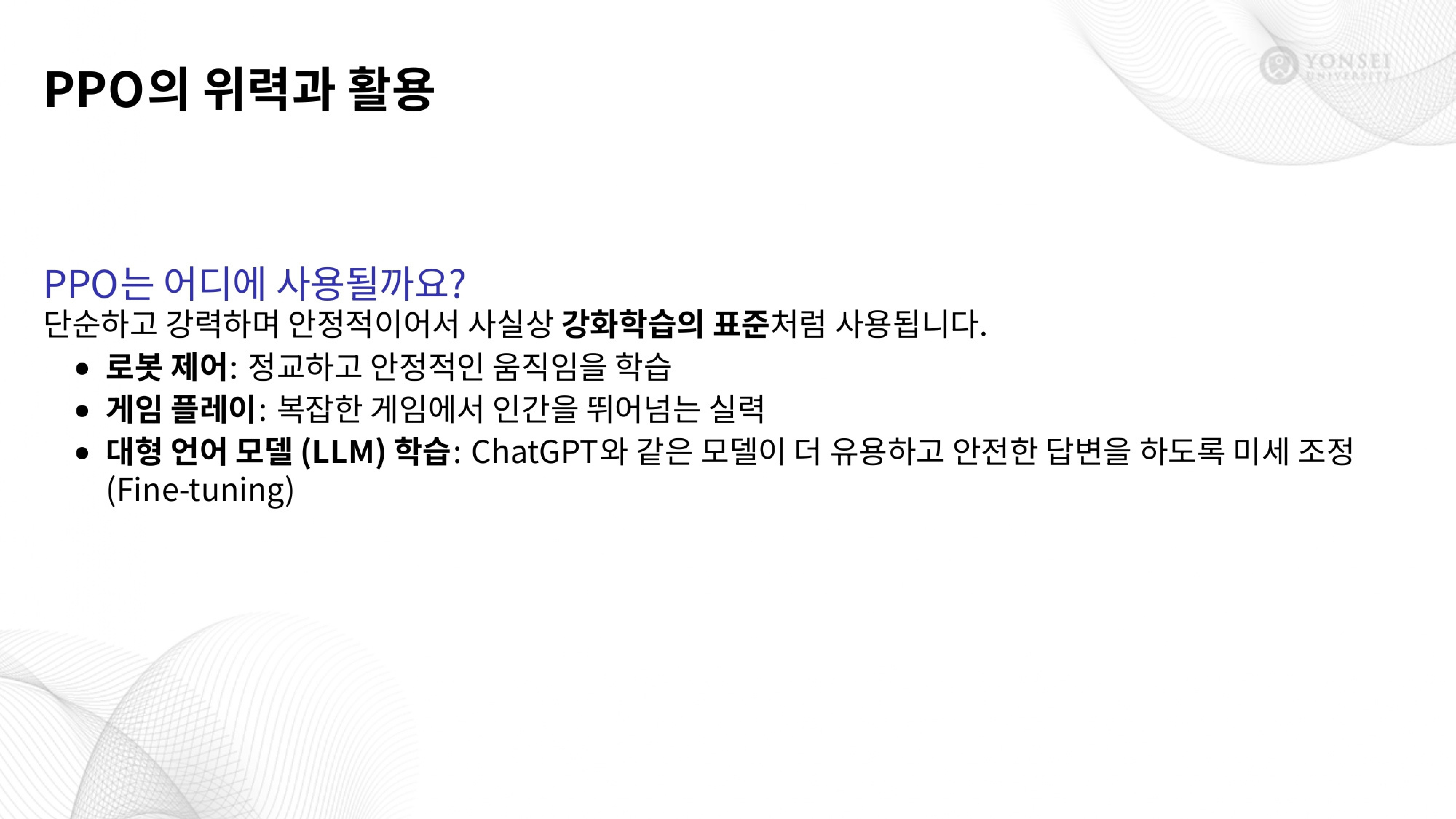
- Why it’s popular: PPO is simple, powerful, and stable, making it the de-facto standard for reinforcement learning.
- Where is PPO used?:
- Robotics: Training stable and precise movements.
- Game Playing: Achieving superhuman performance in complex games.
- Large Language Models (LLMs): Fine-tuning models like ChatGPT to produce more helpful and safer responses (a process known as Reinforcement Learning from Human Feedback or RLHF).
- Major Users: Almost all leading AI companies, including OpenAI, DeepMind, Meta, and NVIDIA, use PPO as a core algorithm.